
Placepot Strategy: Building a Winning Perm
 Available in US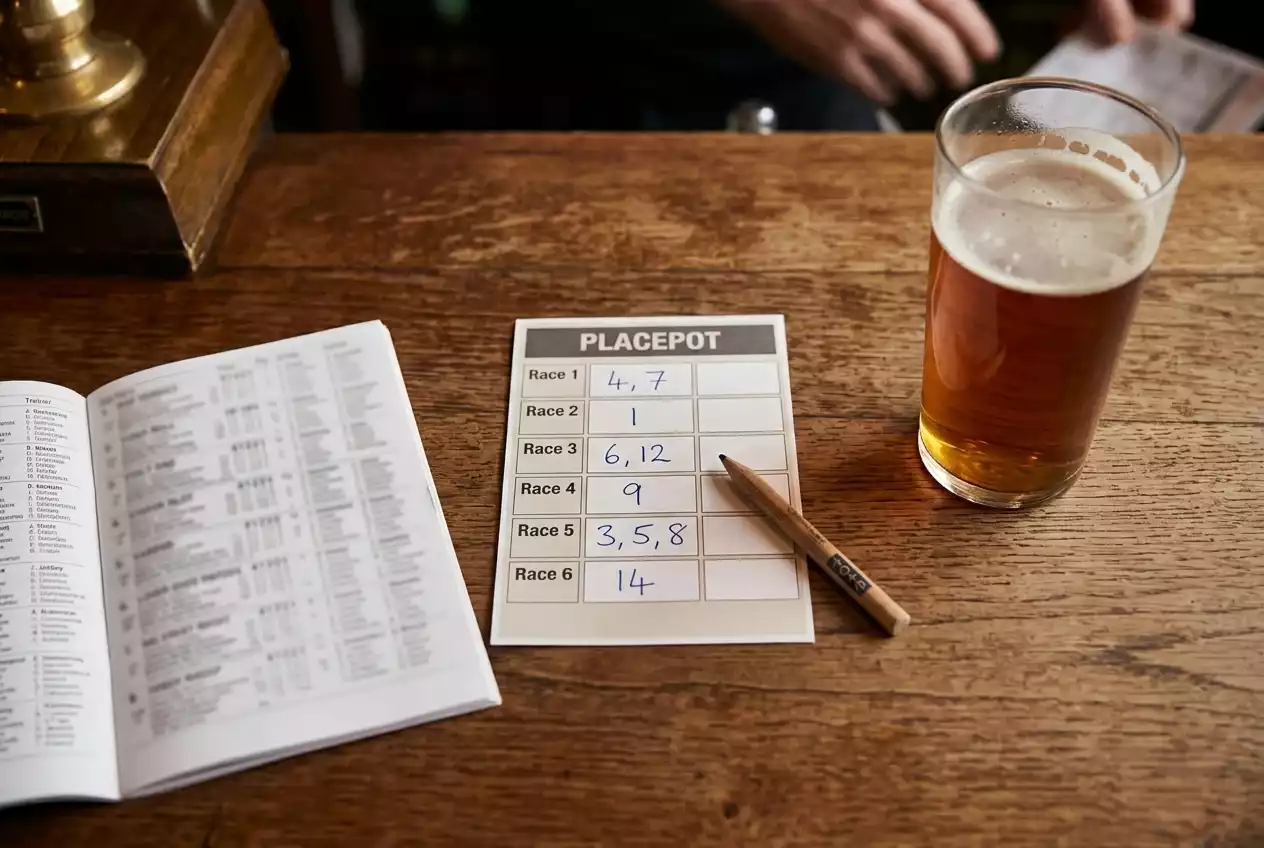
Perm Construction: Optimizing Banker Selection and Pool Analysis
October 2023, an ordinary Wednesday at Kempton, evening floodlit card. I built a £6 placepot perm — a banker in race one, three selections in two, two in three, three in four, two in five, three in six. Sixth race obliged with a placed 16/1 outsider. Dividend: £487 per £1. I came home with just shy of three grand on a card most of the country was ignoring. That is the placepot in a nutshell — long stretches of nothing, then occasionally a midweek payout that makes a serious dent in your annual punting P&L.
The placepot is the most popular pool bet in British racing because it requires no winners. You only need a placed horse in each of the first six races on a card. Get all six placed and you share the pool. Miss one and your slip is binned. Simple structure, brutal mechanics, and a dividend pattern that rewards patience and stake discipline far more than it rewards picking favourites.
I have been playing placepots seriously for eight years. Most days I lose. Some days I get five out of six. A handful of days a year I land the lot. The maths still works because when it lands it lands big.
Why the placepot dividend distribution is so skewed
The placepot is parimutuel — pool money in, deductions out, surviving pool split between winning tickets. Deductions sit around 27 percent, which is steeper than the straight place pool, and the dividend is calculated per £1 unit. What makes the placepot mathematically interesting is the cumulative probability stack.
If you back one horse in each of six races, and each horse has a 35 percent chance of placing, the chance of getting all six right is 0.35 to the sixth power, which works out at roughly 0.18 percent. One in 550-odd. That is why you almost never see a placepot land on a single line — the punters who do well play perms that cover multiple horses in trickier races and lean on bankers in the races they have a strong opinion on.
The dividend distribution is heavily skewed toward outsider-driven outcomes. When favourites place across the card, the dividend often sits at £30 to £80 per £1 — not bad but not life-changing. When even one or two outsiders place in races where the public couldn’t see them coming, dividends regularly clear £500 and occasionally break four figures. Cheltenham Festival placepots have paid out over £10,000 per £1 on days where the chalk took a hammering early.
This skew is your friend. The placepot is not a “back the favourites” game. It is a “find one or two races where you have a contrarian opinion and protect against the public” game. The pool rewards you for being different.
The banker mistake that costs people money every week
The single biggest mistake I see at racecourses, on social media, and in pub conversations is overestimating bankers. A “banker” in placepot language is a single selection — one horse in one race, no cover. You stake the rest of your perm against that horse placing. Sounds rational, looks tidy on the slip.
The problem is the placing strike rate of even very short-priced favourites in competitive racing. A 5/4 jolly in an eight-runner handicap at Lingfield does not place at the rate people expect. Strike rates for short-priced favourites in handicap company hover around 60 to 65 percent over three places. That is roughly one in three failures. Stick two bankers in your placepot and you have a meaningful chance of being out of the bet inside the first 30 minutes of the card.
My rule is one banker per perm at most, and only when the conditions support it. Strong evidence: a horse running off a clearly favourable mark, a sound stable in form, course-and-distance suitability, manageable pace scenario, no obvious downside. Weak evidence: just shortest in the market. The market is wrong often enough about who places that you cannot lean on price alone for a banker decision.
If I cannot find a banker that meets my criteria, I run no banker at all. Two selections in every race. The perm size goes up — typically £64 for a 2x2x2x2x2x2 base unit — but my survival rate through the card improves materially, and that is what makes the bet pay long-term.
Where to spend the perm money
The art of placepot perming is knowing which races to widen and which to narrow. The general principle is to spend more cover in races you can’t read and less in races you can.
Open maidens and novice races are where I always widen. First-time runners, unknown form, market signals all over the place. Three or four selections is normal in these, and even then I’m prepared to lose the bet in race three of the card if a 25/1 shot turns up and stays on. You cannot price the unpriceable. Accept the variance and move on.
Big-field handicaps with no dominant favourite are another spot to widen. Field of 14 to 18 runners, prices spread from 5/1 to 33/1, three places paying. You need at least three selections, ideally four, to give the bet a fighting chance. Trying to cover a competitive handicap with one or two selections is how you blow placepots cheaply.
Small-field conditions races and listed contests are where I narrow. Six- to eight-runner fields, two or three places paying, clear form lines, clear market. One selection is often enough if the conditions favour your horse. Two if you have a genuine doubt. Three is wasteful — you are just buying coverage on horses that don’t need it.
The final race on the card is worth special attention. Late on a busy day, attention drops, dividends spike when the closer goes off-piste, and a wide perm in the sixth race is often where the surprise dividend lurks. I almost never narrow the last leg below two selections regardless of how strong the favourite looks.
The maths on perm sizing and stake-to-cover ratios
A placepot perm is multiplicative. If you pick three horses in one race and two in the next, you have six lines. Stretch that across six races and the numbers grow fast. Worked examples that come up repeatedly in my own perming:
1x2x3x2x2x3 with £0.50 unit stake. Lines: 1 x 2 x 3 x 2 x 2 x 3 = 72 lines. Total stake: £36. Affordable, covers reasonable opinion across the card, gives you decent survival probability through the trickier races.
2x2x3x3x2x3 with £0.20 unit stake. Lines: 2 x 2 x 3 x 3 x 2 x 3 = 216 lines. Total stake: £43.20. No banker, full coverage on the two trickiest races, sensible unit stake. This is my default shape for a competitive Saturday card.
1x1x3x4x2x3 with £0.50 unit stake. Lines: 1 x 1 x 3 x 4 x 2 x 3 = 72 lines. Total stake: £36. Two bankers, both in early races where you have strong opinions, wide coverage in the trickier middle legs. Higher reward if the bankers hold but higher bust-out risk too.
The stake-to-cover ratio is the metric I track. If I am putting £40 into a perm, I want at least 150 lines of cover — meaning my average unit stake sits around £0.25. Anything tighter than that and I am paying too much for too little coverage on a bet that depends on coverage to pay out.
Reading the placepot pool before the off
The Tote publishes the placepot pool size in real time across the betting day. Pool size matters because it tells you two things — how much money is committed to chase, and how much shape the pool has likely taken.
Saturday afternoon featured cards regularly carry placepot pools of £200,000 to £500,000. Cheltenham Festival days routinely push beyond £1 million. Midweek racing at smaller tracks might see pools of £20,000 to £50,000. Pool size determines whether your perm is worth running — a thin pool means even a successful placepot pays modest money, while a fat pool means a single winning line can return many thousands.
The Tote also operates guaranteed minimum pools on selected meetings. If the actual pool comes in below the guarantee, the operator tops it up to the published minimum. These guarantee meetings are worth seeking out because they shift the maths in the punter’s favour — you are betting into a larger effective pool than the pure punter-driven money would produce. Pool turnover across British racing has been under sustained pressure, with Q3 2025 figures coming in 12.8 percent below 2023 levels, and the guarantee pools are part of how the Tote operator defends placepot liquidity.
The discipline that separates winning placepot players from losing ones
Three habits I have learned the hard way, each of them more important than any single perming technique.
Set a budget per perm and stick to it. The placepot is variance-heavy. You will go weeks without a return. If your stake exceeds what you can comfortably lose without it affecting your week, you will start chasing losses, building larger perms to compensate, and the maths gets worse the bigger you stake into bets you cannot afford. Pick a unit you are happy to lose six times in a row. That is your perm size.
Don’t change your perm at the last minute. Late market moves, last-minute opinions from the form pages, rumours circulating in the betting ring — none of this is useful information at the placepot stage. You did the work before the card. Trust it. Late changes consistently make perms worse, not better, in my own data.
Walk away from cards you can’t read. There are days when I look at a placepot card and cannot form an opinion on three of the six races. That is a signal to skip the bet entirely, not to throw wider coverage at it. The placepot rewards opinion. If you have no opinion, you have no edge, and the deduction is eating you alive.
The placepot is one of British racing’s most distinctive bets. It does not exist in most international jurisdictions in the same form, and the dividend structure makes it genuinely attractive once you understand how to perm it sensibly. Spend the work on the card, manage your stake, accept the variance, and the long-run numbers tend toward the punter when the bet is treated with respect rather than as a lottery ticket. For broader context on how the same six-race discipline applies to chained place bets across multiple meetings, the structure of place-only accumulators covers the multiplicative maths from a different angle.
What is the difference between a placepot and a jackpot bet?
A placepot requires a placed horse in each of the first six races on a card. A jackpot requires winners in the same six races. Placepots have a much wider winning population and far lower dividends on average.
How much should I typically stake on a placepot perm?
Most regular placepot players run perms between £10 and £50 with unit stakes from £0.10 to £0.50. The key is matching perm size to coverage — at least 150 lines of cover per £40 staked is a reasonable starting point.
Why do placepot dividends vary so dramatically between cards?
The dividend depends on how many winning tickets share the surviving pool. When favourites place across the card, many tickets survive and the dividend is modest. When outsiders place, few tickets survive and the dividend spikes.
This material was created by the PlaceLedger team.
Related posts
In-Play Place Market Mechanics: How Live Pricing Actually Works During a Race

UK Betting Taxation: How the Punter’s Tax-Free Status Actually Works