
In-Play Place Market Mechanics: How Live Pricing Actually Works During a Race
 Available in US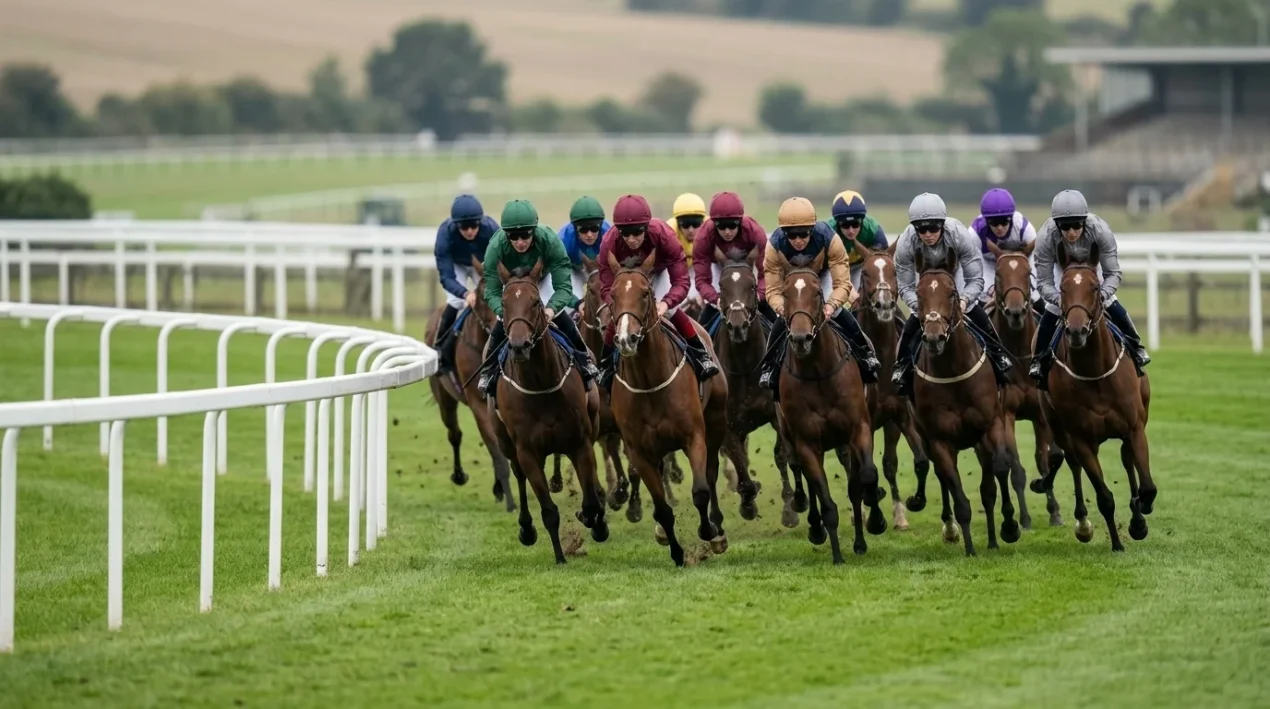
The two-furlong moment that taught me how the in-play market actually moves
Doncaster, last race of a Saturday card, October 2023. A handicap chase, sixteen runners, four places paying. I had a 10/1 shot in the each-way market that broke well and travelled smoothly through the early circuit. Two fences from home he was sitting in second, going easily, looking sure to place. The in-play price on his place market dropped from 4.0 pre-race to 1.4. I held my position rather than trading out. He hit the second-last hard, lost momentum, and faded to fifth on the line. The fixed-odds place bet was dead. The in-play price had been clearly telling me the structure of the race had de-risked into a probable placing — and I had ignored the signal in favour of leaving the original bet to settle naturally. That moment cost me about £80 and taught me more about in-play place trading than any amount of theoretical reading.
In-play betting on horse racing is a younger phenomenon than fixed-odds pre-race markets. The technical infrastructure that makes real-time price updates feasible — high-frequency data feeds from racecourse video, low-latency pricing engines, mobile interfaces fast enough to allow user interaction during a race — only matured in the late 2010s. The result is a market that adds genuine optionality to the punter’s toolkit but that requires fundamentally different mental models from pre-race betting to use well.
I have been working with in-play place markets for the better part of a decade. The lessons that stuck are about timing, liquidity, the relationship between visible race position and underlying probability, and the discipline required to use the market as a tool rather than as an entertainment.
How in-play place pricing actually gets calculated
In-play prices update in real-time based on the changing probability of each runner finishing in the qualifying placed positions. The underlying mechanism is an algorithmic pricing engine that takes inputs from race state — position, pace, distance remaining, sectional times where available — and outputs updated probability estimates for each runner’s place outcome.
The pricing engine is calibrated against historical race patterns. A horse sitting in second place with two furlongs to go has a certain historical probability of holding a placed position based on patterns observed across thousands of similar race situations. The algorithm uses this base rate as a starting point and adjusts based on additional inputs — the prevailing pace, the strength of the closer behind, the form of the running horses, the conditions of the day. The resulting probability is converted to odds and pushed to the market in milliseconds.
The market then prices against this algorithmic feed combined with user betting activity. Heavy backing of a particular runner pushes its place price down further than the pure algorithmic estimate would suggest, and corresponding lay activity pushes it back up. The visible price at any moment is the combination of algorithmic feed and market activity, refreshed every few seconds across the duration of the race.
For shorter races — sprint contests of five or six furlongs — the in-play market is brief and the pricing engine has limited input data to work with. For longer races — staying chases of three miles or more — the in-play market has substantial time to evolve, the pricing engine has detailed positional data through the running, and the price updates are more meaningful as signals about underlying probability shifts.
The latency problem that no one talks about
The structural challenge of in-play betting on horse racing is latency — the delay between events on the track and price updates reaching the customer interface. Different sources of race information operate at different latencies, and the gap between the fastest and slowest sources is large enough to create genuine information asymmetries.
The fastest information source is being at the racecourse, watching the race live. The latency is essentially zero — you see what is happening as it happens. The next fastest is a high-quality direct-from-racecourse video feed, typically used by professional operators and high-spending customers. The latency here is one or two seconds depending on the technical infrastructure.
Mass-market television broadcast adds substantial latency on top. A typical broadcast feed shown on ITV or Sky Sports Racing carries a five to fifteen second delay relative to the live event. A streaming feed through a bookmaker’s website or app may add further latency depending on the streaming infrastructure. The cumulative gap between a customer watching a stream on their mobile phone and a professional with direct racecourse access can be ten to twenty seconds.
What this means in practice. The customer placing an in-play bet through their mobile interface is typically reacting to information that has already been priced into the market by faster-information participants. The price the customer sees is the price after the algorithmic feed and the faster-information traders have already adjusted to the event the customer is just now witnessing. The casual in-play punter is structurally at an information disadvantage that is invisible to them at the moment of betting.
The implication is straightforward. In-play betting based on what you are seeing on your screen at the moment of placing the bet is rarely a value proposition because the value has typically been priced out before your bet reaches the market. The use cases where in-play betting does offer value are different from this naive pattern, and recognising the difference is the central skill in using in-play markets well.
Where in-play place trading actually offers value
Three specific patterns where I have found in-play place markets to offer genuine value, distilled from many years of trial and error.
The early-pace trade. If you have a clear view on how the race pace will develop and that view is at odds with the consensus, in-play betting in the opening stages of the race can be valuable. Example: a long-distance race where you expect the pace to collapse and a hold-up horse to be advantaged. As the race develops and the pace collapse becomes visible, the in-play price on your hold-up horse may not yet have fully adjusted because the market is still digesting the unfolding scenario. A back-bet at this stage can return materially better value than the pre-race odds would have suggested.
The trading-out hedge. If you have a strong pre-race position on a horse and the in-running price moves significantly in your favour, trading out part or all of the position locks in profit while the underlying outcome is still uncertain. The trade is straightforward — back the original horse at race time, lay the same horse at in-play odds once the price has tightened, and the net position is a guaranteed return regardless of whether the horse ultimately places. The pattern works particularly well on stayers who travel strongly through the middle stages of long races.
The end-of-race recovery trade. The opposite of the trading-out hedge. If your horse is travelling badly through the middle stages of a race but you have a strong view that the underlying ability is there and the race shape will favour late closers, in-play backing as the price drifts can produce substantial returns when the horse stays on into placed positions. The trade is high-variance and requires confidence in your form judgement over the visible race position, but the returns when it works are large.
None of these three patterns relies on faster information than the algorithmic pricing has access to. They rely on judgement and form-reading skill that the algorithmic pricing engine cannot replicate. The structural value comes from being able to apply judgement faster than the pure market consensus catches up.
Liquidity dynamics in in-play place markets
The same liquidity asymmetries that affect pre-race exchange markets apply to in-play markets, often more acutely. Major Saturday Group races at Ascot or Newmarket carry substantial in-play matched volume — easily into six figures of matched money on the major contests. Midweek racing at smaller tracks carries in-play liquidity that may be only a few thousand pounds across the entire field.
Thin in-play markets produce wide bid-ask spreads that compound the structural latency problem. A 10 percent spread on a thinly-matched in-play place market means that any stake that crosses the spread is paying 10 percent before any consideration of whether the underlying view is correct. Add the latency disadvantage on top, and the structural cost of in-play betting on thin markets becomes prohibitive for any but the largest stakes from informed traders.
The practical rule I follow is to limit in-play place trading to races with substantial pre-race matched volume in the place market. If the pre-race volume was meaningful, the in-play volume will typically be sufficient to support reasonable stakes without wide spreads. If the pre-race volume was thin, the in-play market will be even thinner, and the structural costs make trading unattractive.
Exchange-based in-play markets generally offer tighter spreads than bookmaker in-play markets at the same liquidity level, because the exchange is matching customer orders directly against each other. For serious in-play trading, the exchange is the preferred venue almost universally.
The mental discipline required to use in-play well
In-play betting attracts a particular type of casual punter — the one who bets because the action of betting is part of the entertainment of watching racing. The combination of live action, fast price updates, and instant gratification makes in-play betting psychologically engaging in ways that pre-race betting is not. The engagement is what produces the impulsive losing stakes that drain bankrolls.
The discipline that separates successful in-play traders from unsuccessful in-play punters is the willingness to skip races where no trade is identifiable. The market generates apparent opportunities continuously across every race, but the genuine value opportunities are infrequent. Most races run with the in-play market behaving exactly as the pre-race form would have predicted, and no genuine mispricing emerges.
The mental model I have found useful is to treat in-play betting as a specific intervention rather than as continuous engagement. You watch the race. You wait for a specific identifiable misalignment between the visible race state and the in-play price. If the misalignment doesn’t emerge, you don’t bet. If it does, you act decisively. The pattern is closer to professional poker betting than to recreational sports betting — selective, judgement-based, focused on specific identifiable mispricings.
For most place-betting punters most of the time, the right approach to in-play markets is to use them rarely if at all. The structural costs of latency and spread, combined with the psychological pull of continuous engagement, make in-play a hostile environment for casual users.
The place of in-play in a complete place-betting toolkit
In-play place markets sit alongside fixed-odds pre-race betting, Tote pool betting and exchange pre-race betting as one of the four major venues for committing place stakes on UK horse racing. Fixed-odds pre-race is the workhorse — simple, broadly available, and supported by promotional terms that the other venues don’t offer. Tote pool offers value on specific race types and field shapes that the fixed-odds market doesn’t fully price. Exchange pre-race offers bidirectional flexibility and tighter spreads for users with the patience to set their own prices. In-play offers the optionality to react to unfolding race events but at substantial structural cost.
The integrated approach combines all four venues, allocating stake to whichever offers the best value for the specific bet structure being placed. Most place stakes still flow through fixed-odds pre-race for good reason. The other three venues are tools to deploy when the specific conditions favour them.
The deepening of the regulatory framework around all of these venues has been one of the structural features of the UK betting market over the past five years. Customer protection requirements apply equally across fixed-odds, exchange and pool channels. The Single Customer View pilot is building cross-channel visibility infrastructure. For the structural detail on how the broader protection framework operates across all of these channels, the breakdown of customer interaction obligations covers the operator-facing requirements that apply to in-play markets the same way they apply to pre-race betting.
Why is the in-play price often different from what the visible race position would suggest?
The pricing algorithm factors in pace, sectional times, distance remaining, and form information beyond pure positional data. A horse leading at one furlong may have a worse place probability than the visible position suggests if the underlying race shape favours late closers.
Is in-play betting available on every UK horse race?
Most major UK racing offers in-play betting through licensed operators, but availability on smaller midweek meetings can be patchy depending on operator coverage. Liquidity also varies substantially — major meetings carry deep in-play markets, minor meetings often carry thin ones.
Can I trade out an in-play position before the race ends?
On betting exchanges, yes — you can lay off an existing back position at any time while the in-play market is open. On bookmaker in-play markets, cash-out functionality serves a similar purpose, though the bookmaker’s cash-out price typically embeds a wider margin than the equivalent exchange trade.
This material was created by the PlaceLedger team.
Related posts

UK Betting Taxation: How the Punter’s Tax-Free Status Actually Works

UK Youth Gambling Patterns: What the 2025 Data Shows and Why It Matters for the Future Market