
The Decline of the UK Betting Shop
 Available in US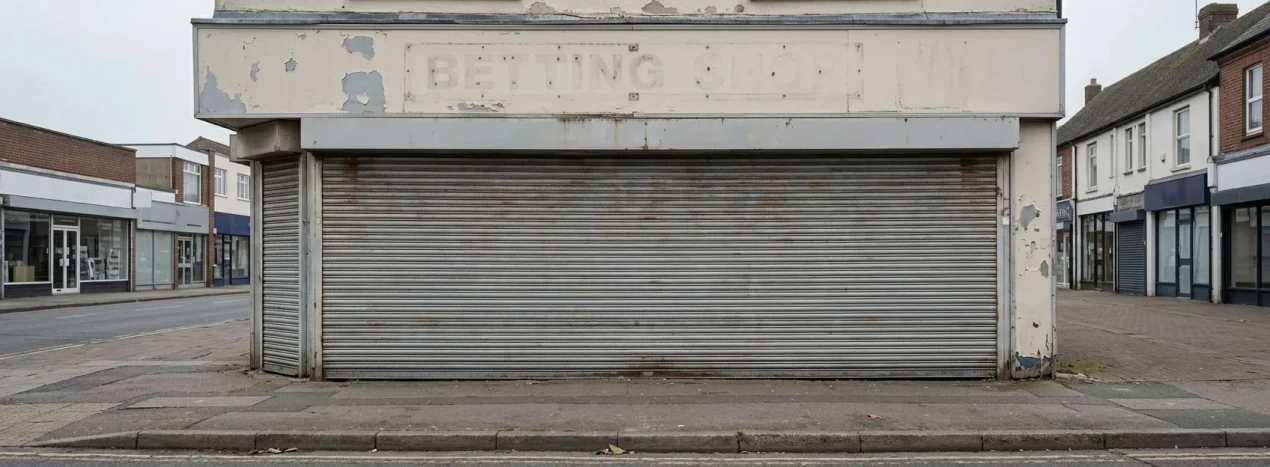
Retail Betting Economics: Revenue Shifts and Online Migration
Saturday afternoon, early 2024, I was passing through the small Hertfordshire town where I’d grown up and decided to drop into my old local shop to put a Royal Ascot ante-post bet on. I knew the place — used to go in regularly through my twenties. Walked round the corner, looked for the familiar sign, and found a coffee shop in its place. Exposed brickwork, oat milk lattes, a queue of pram-pushing parents. The bookmaker had closed eighteen months earlier and the unit had been redeveloped. The next nearest shop was a fifteen-minute walk away. By the time I got there I had already placed the bet on my phone.
The UK betting shop is not dead but it is in serious structural decline. The most recent Commission industry statistics record 5,931 licensed betting premises across Great Britain — the tenth consecutive reporting period of decline, with a cumulative reduction of 1,808 premises (17.8 percent) below pre-pandemic levels. The high street betting shop, once one of the most ubiquitous fixtures of British towns, has been retreating from the streetscape at a steady pace for over a decade. The reasons for the decline are multiple, the consequences for the racing industry are real, and the experience for individual place punters has changed in ways that go beyond convenience.
I have been a regular at high-street betting shops for most of my adult life. The shift from physical to digital has been the dominant feature of UK betting across the past fifteen years, and the shop network reduction is the most visible manifestation of that shift.
Why the shops are closing
The structural decline of the betting shop network reflects several converging pressures, each of which has been working against the high-street model.
The shift to digital betting is the headline pressure. UK online gambling has been growing consistently for over a decade, with online GGY up 8 percent year-on-year in the second quarter of 2025 within a broader market that reached £16.8 billion in total Gross Gambling Yield across the year to March 2025. The digital share of total betting volume has grown from a minor segment in the early 2000s to the dominant channel in 2026. Every percentage point of share that moves to digital is a percentage point that is no longer transacted in physical shops, and the digital share has grown almost monotonically across the period.
The 2019 Fixed Odds Betting Terminal stake reduction was the second major structural pressure. The cap reduced maximum stakes on FOBTs from £100 to £2 per spin, and FOBT revenue had been a substantial contributor to shop economics for the previous decade. The stake reduction wiped out a significant portion of shop revenue and accelerated the closure programme that operators were already planning across underperforming units.
Rising operational costs across the high street have compounded the revenue pressure. Commercial rents, business rates, staff costs, energy costs — all of these have grown faster than shop revenue, and the resulting margin compression has made marginal shops uneconomic to maintain. The closures have concentrated in towns with weaker retail economies generally — areas where multiple high-street sectors are also retreating.
The regulatory layer has added compliance cost without offsetting revenue. Customer interaction obligations, age verification requirements, AML compliance, and the broader Commission compliance framework all apply to shops in the same way they apply to online operators, but the relative cost of compliance is higher for the smaller revenue base of an individual shop. Each tightening of the regulatory framework has marginally worsened shop economics relative to the equivalent online operation.
The geography of decline and what’s left
The 5,931 licensed betting premises figure is a national total but the geographic distribution is uneven. Densely populated urban centres — London, Manchester, Birmingham, Glasgow — retain substantially more shop coverage than rural areas. Small market towns and outer-suburban high streets have seen the most aggressive closure programmes. The shop network has concentrated where the local economics still support it.
The 3,086 total licensed activities figure across the broader UK gambling market for the year to March 2025 — itself down 2.3 percent on the previous year — captures the broader decline in licensed gambling premises across all formats including shops, casinos and amusement arcades. The shop network is the largest component of this total but the decline pattern is visible across the broader land-based sector.
What remains of the shop network has changed in character. Surviving shops tend to be larger, better-located, and more invested in than the pre-decline average. The closures have been concentrated in marginal units, and the remaining estate is typically the high-revenue end of the previous network. The experience of using a high-street shop in 2026 is, paradoxically, often better than the experience was in 2015 — the shops that have survived are typically the ones with adequate space, staff and amenity.
Regional differences in shop concentration matter for racing specifically. Areas with strong historical racing culture — Yorkshire, Newmarket, the West Country — retain higher relative shop density than areas without that cultural attachment. The shops in these areas tend to be more specialised in racing than equivalent shops in mainstream high-street locations, and the conversational and informational atmosphere is materially different.
What’s lost when a shop closes
The functional substitute for a closed shop, for most users, is the betting app on a mobile phone. The substitution is straightforward in transaction terms — you can place the same bet, get the same odds, settle the same way. What is not substituted is the social and informational architecture that the physical shop provided.
The high-street betting shop has historically been one of a small number of public spaces in British towns where strangers shared an interest, exchanged opinions, and built loose social networks around a common activity. For many regular users, the shop was a form of community space rather than purely a transaction venue. The closure of these spaces removes a public good that doesn’t show up in any betting industry statistic.
The informational quality of conversation in a busy betting shop on a Saturday afternoon was meaningful. Local form opinions, trainer notes, paddock observations from punters who’d attended local meetings — this was a form of crowdsourced racing intelligence that the digital channels do not fully replicate. Online forums and social media partially substitute but the dynamics are different, and the quality of casual conversation between strangers who share a physical space is hard to replicate.
For older punters specifically, the shop closures have been disproportionately consequential. Older users are over-represented in shop-using populations and under-represented in app-using populations. The shift from shop to digital has displaced more older users from the betting market than it has attracted new older users into the digital channel.
The on-course betting alternative and its trajectory
On-course betting at British racecourses has held up better than the high-street model and has actually grown in recent years. Total UK racecourse attendance reached 5,031,640 in 2025 — up 4.8 percent year-on-year and the first time the total exceeded five million since 2019. The average attendance per fixture rose 3.6 percent to 3,526 across 1,427 fixtures. Q1 2026 attendance of 696,611 was up 4.5 percent on Q1 2025, and Cheltenham Festival attendance in 2026 reached 225,252 — a 3.3 percent increase on 2025.
Under-18 attendance growth has been particularly strong, up 17 percent in 2025. This suggests that the racecourse experience continues to attract younger audiences even as the high-street shop network shrinks. The two trends are pulling in opposite directions, and the implication is that British racing’s audience reach has been holding up better than the shop network decline alone would suggest.
On-course bookmakers and the Tote pool operation through Britbet remain a substantial source of liquidity at major meetings. The on-course betting ring is a different cultural experience from the high-street shop but it preserves some of the same social and informational functions for the punters who attend in person. The combination of on-course attendance growth and high-street closure suggests that the betting culture is becoming more concentrated around the live event experience and less embedded in daily life through the shop network.
The implications for racing’s economic structure
The Horserace Betting Levy collected £108.9 million for 2024-25 — a record figure since the 2017 reform of the levy system. The shop network historically generated substantial levy contribution as a primary distribution channel for racing bets. As the shop network has shrunk, the levy contribution from physical channels has declined and the digital channels have absorbed more of the volume. The transition has been broadly neutral for total levy yield — digital betting on racing has grown as shop betting has declined — but the channel mix has shifted significantly.
Turnover per race across British racing fell 8 percent year-on-year in 2024-25 and was 19 percent below 2021-22 levels. The trend continued into Q3 2025 with turnover 12.8 percent below 2023 levels. Premier Fixtures saw turnover per race rise 2.7 percent in 2025 while Core Fixtures saw turnover fall 8.6 percent. The bifurcation between premier and core racing reflects the concentration of attention and stake on the marquee meetings, with everyday racing seeing the steepest declines. The shop network decline is part of this picture — shop closures have disproportionately reduced the betting volume on everyday weekday racing because the shop user base was more evenly distributed across the calendar than the digital user base is.
The economic structure of British racing remains substantial. The industry supports approximately 85,000 jobs directly and indirectly, contributes more than £4.1 billion to the UK economy with direct revenue of £1.47 billion. The shop network decline is reshaping the channel mix without yet reducing the total economic footprint, but the longer-term trajectory of the relationship between racing and physical retail betting remains uncertain.
What the typical place punter actually loses
For an individual place punter who is now habituated to digital betting, the practical loss from shop closures is small. Apps offer better odds comparisons, faster bet placement, more comprehensive markets, and access to BOG and extra-place promotions that shops often did not match. The functional substitution is good enough for most users.
What is lost is harder to quantify. The casual informational exchange with strangers, the texture of Saturday afternoons spent in a particular kind of public space, the experience of watching races on shared screens with people invested in the same outcome — these are not transactions. They are social and cultural experiences that the digital channel does not fully replicate. The shop network decline is partly an efficiency story (digital is more efficient than physical) and partly a cultural change story (something is being lost that was not purely transactional).
For new entrants to the place-betting market, the absence of the shop infrastructure means a different first experience of betting. The on-course route still exists for those who attend race meetings, and the racecourse environment offers a richer experience than the high-street shop ever did. The app-only route has become the default for most new users, and the cultural learning that came from extended exposure to the shop environment is now compressed into in-app onboarding flows and information panels. The substitution is not perfect, but it is what the market has produced.
The licensed market remains the right venue for UK punters regardless of the channel mix shift. The unlicensed offshore alternative offers neither the protection of the regulated framework nor the cultural infrastructure of the legitimate sector. For the structural detail on why staying within the licensed perimeter matters, the breakdown of UK black-market betting risks covers the specific consumer-protection gaps in the unlicensed channel.
Why have so many UK betting shops closed?
The combination of digital substitution, the 2019 Fixed Odds Betting Terminal stake reduction, rising high-street operating costs and growing regulatory compliance costs has made marginal shops uneconomic. The decline has been steady across the last decade rather than driven by any single event.
Are on-course betting rings declining at the same rate as high-street shops?
No. On-course betting at British racecourses has held up substantially better, with attendance growing 4.8 percent in 2025 to over five million. The on-course experience offers a different value proposition that the high-street model could not replicate.
What happens to the Horserace Betting Levy as shops close?
The levy contribution from shop channels has declined as the network has shrunk, but digital channels have absorbed the volume. Total levy yield reached a record £108.9 million for 2024-25 despite the shop decline.
This material was created by the PlaceLedger team.
Related posts
In-Play Place Market Mechanics: How Live Pricing Actually Works During a Race

UK Betting Taxation: How the Punter’s Tax-Free Status Actually Works