
Royal Ascot Place Betting and Market Shifts
 Available in US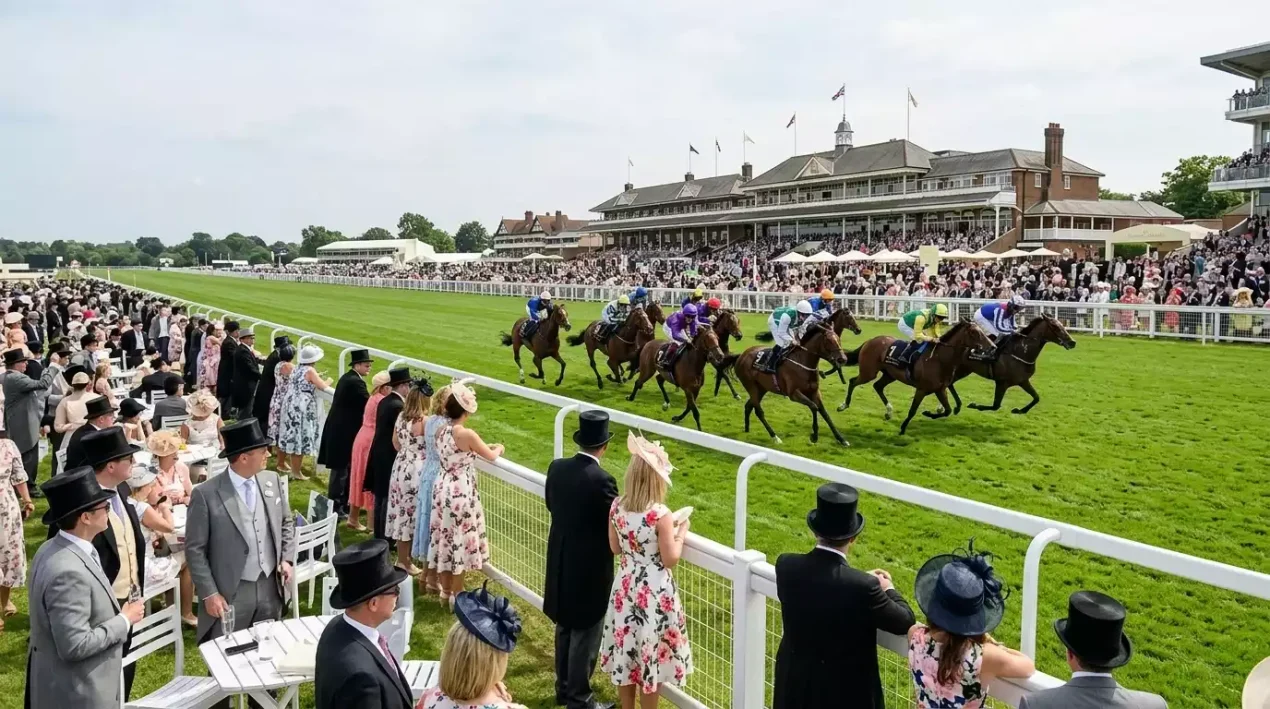
Ascot Liquidity: Enhanced Terms and Group Race Market Patterns
Royal Ascot 2023, Saturday afternoon, the Wokingham Stakes. Thirty runners, a fiercely competitive sprint handicap, places paying down to six with the major firms running extras. I’d marked one horse on the Wednesday — a four-year-old from a yard that targets this race annually, drawn well, dropped to a workable mark. Backed each-way at 25/1 with six places. The horse ran on to nick fourth by a head. £15 stake returned £108. The five-day meeting cost me £210 in stakes across the week and that single bet covered everything plus £6.30 profit. That is Royal Ascot in microcosm — the place market on the big handicaps is where the meeting’s value clusters, and the rest is mostly theatre.
Royal Ascot is the flat racing showpiece of the British calendar. Thirty-five races across five days, every race carrying group, listed or premium handicap status, total prize money north of £10 million, fields that include the best horses in training from every major flat racing jurisdiction. The betting market is as deep and competitive as any in the world. The promotional intensity from UK bookmakers during the meeting is genuinely substantial — extras places, BOG, money-back specials, ante-post enhanced terms — all stacked across the same five days.
I have been betting Royal Ascot for fifteen years. The lessons that stuck are about which races to target, how to use the promotional layer without being seduced by it, and how to read the meeting’s unique market characteristics that don’t apply elsewhere in the calendar.
Where the value lives across the five days
The thirty-five races at Royal Ascot break into three rough categories from a place-betting perspective, each with very different value characteristics.
The Group 1 contests — Queen Anne, King’s Stand, St James’s Palace, Prince of Wales’s, Gold Cup, Coronation, Commonwealth Cup, Diamond Jubilee. Small fields of six to twelve runners, two or three places paying, dominated by short-priced favourites with strong each-way profiles. Place value is structurally limited here because the market is efficient, the participants are well-known internationally, and there is little room for mispricing. Backing a horse to place in the St James’s Palace at 11/4 is unlikely to be a profitable long-run bet — the price reflects the place probability accurately and the each-way structure adds no edge.
The Group 2 and Group 3 races — Norfolk, Queen Mary, Coventry, Hampton Court, Ribblesdale and similar contests. Medium fields of eight to fifteen runners, three places paying, more competitive each-way markets because the participants are less internationally proven and the form lines are less complete. These races offer genuine each-way value on the right selection, particularly two-year-old races where market signals are noisier and the smarter form analysis carries an edge. This is where I commit most of my place stake across the meeting.
The premium handicaps — Wokingham, Royal Hunt Cup, Britannia, Ascot Stakes, Buckingham Palace, King George V, Duke of Edinburgh. Large fields of twenty to thirty runners, four places paying as standard with extras places promotions pushing the count to five or six, prices spread from 5/1 down to 100/1. The handicaps are structurally the best each-way racing in the world for the punter. Bookmakers running extra places on these contests are paying out on five or six finishers in fields where four would be the regulation. The maths shifts meaningfully in the punter’s favour whenever extras are running.
The handicaps are where serious Royal Ascot money should be deployed. Group races are for entertainment and minor side bets. The handicaps are the meal.
Extra places and how to compare the actual offers
Every major UK bookmaker runs extras places promotions across Royal Ascot week. The structure is identical across firms — extra places paid on top of the standard four places in the big handicaps — but the specific terms vary significantly and the gap between the best and worst offers is real money.
The two variables are number of extra places and the odds reduction (if any). Some firms run five places at 1/4 of the win odds, matching standard each-way terms. Others run six places at 1/5 of the win odds — more places but lower per-place return. A few run seven places at 1/6 or even 1/7 odds, which is impressive on paper but produces tiny place returns on short-priced runners.
The maths comparison matters. £10 each-way at 20/1 with five places at 1/4 produces a place return of £60 if the horse runs into one of the qualifying places. The same £10 each-way at 20/1 with six places at 1/5 produces £50. The fifth place is more likely to be paid in the second offer, but the per-place return is 17 percent lower. Whether the trade-off is worth it depends on how confident you are that the extra place is the difference between a winning and losing bet.
For long-priced runners — anything 25/1 or longer — I almost always prefer more places over higher odds. The marginal probability gain on the sixth or seventh place against a 33/1 outsider that closed strongly is meaningful, and the per-place return is still substantial at 1/6 odds. For shorter-priced runners — 8/1 to 16/1 — the calculation flips, and the higher odds ratio at fewer places usually delivers better expected return.
One other detail to watch. Some extras places promotions require BOG to be applied, meaning you settle on the starting price if it’s longer than your taken price. Others apply BOG on the win element but use taken-price odds for the place element. Always check this for your specific firm and your specific bet — the difference can be material on horses whose price drifts before the off.
The market for the meeting is shaped by promotional intensity
One of the structural features of Royal Ascot week is how heavily UK firms market the meeting to recreational punters. Promotional spend across the industry runs into tens of millions over the five days. The visible effect is the extras places offers, the BOG promotions and the ante-post enhanced terms. The less visible effect is on overall market liquidity and pricing efficiency.
Casual betting volume floods the market during Royal Ascot. Punters who don’t normally bet on racing — and many who don’t normally bet at all — place stakes during the meeting because it’s a national event. This volume tends to concentrate on famous horses and recognisable trainers rather than on form-based value selections. The market consequence is that less heralded runners often retain better value than they would in normal weekday racing because the casual money is not pricing them in.
This is most pronounced in the premium handicaps. The 33/1 outsider in the Wokingham who has done his best running on Ascot’s stiff finish over the past two seasons gets backed by form students for his profile, but the broader market money concentrates on the favourite or on horses ridden by famous jockeys. The price holds at 33/1 even as the form case strengthens during the week. Similar dynamics across most of the handicap card.
What this means in practice. The Royal Ascot betting market is a high-attention, high-promotion environment where the pricing efficiency is excellent on the top end and surprisingly weak in the middle and back end of competitive handicaps. Value clusters in the unfashionable third or fourth of the market for big-field races. Patient form study in those zones consistently pays off across the meeting.
Going and draw — the two factors that move every Ascot place market
Two race-specific variables drive place market movement at Royal Ascot more than anywhere else in British flat racing. Pay attention to both during the week and the market becomes meaningfully more readable.
The going at Ascot is mercurial. The Berkshire weather in June can produce anything from rock-hard ground to dead, easy turf. Watering policy on the racecourse is aggressive and the official going can change between Monday morning and Tuesday’s first race, then change again between Wednesday and Thursday. Horses with strong going preferences see their place market prices move sharply when the going changes — a soft-ground stayer drifts 20 percent on a going change to good-firm, and steams equivalently on rain.
The draw at Ascot’s straight course is the other major variable, particularly on the round course’s flying mile and the straight sprint courses. Stalls draw can be the difference between a clear run and a lost cause. Draw biases at the meeting are well-documented but the specific applicable bias depends on the going and the prevailing field pattern. A high draw advantage in a Wokingham field that races on the stand side becomes irrelevant if the field migrates to the far rail. Watch the early races on each day to see where the field is racing before committing on the later races.
Both factors should be reflected in the place market price by race-time but often aren’t, particularly on outsiders. A 25/1 shot drawn favourably in a sprint with a sharp stand-side bias might still trade at 25/1 with major firms ten minutes before the off because the casual money is on the famous horses regardless of stall positions. This is a genuine value pocket. The exchange place market typically reflects draw and going more efficiently than the fixed-odds market does.
Royal meeting attendance and what that means for market quality
Royal Ascot drew approximately 300,000 attendees across the five days in 2025, part of a broader pattern where UK racecourse attendance reached 5,031,640 in 2025 — up 4.8 percent year-on-year and the first time the figure exceeded five million since 2019. The 2026 numbers for Ascot have not yet been compiled in full but the early-season trend is positive, with Q1 2026 attendance across UK racing up 4.5 percent on the equivalent quarter the year before at 696,611.
What does attendance have to do with place market quality? The on-course betting volume at major meetings is a meaningful source of liquidity, and reuniting the Tote pools with the Britbet on-course system has further consolidated that liquidity. On a featured Royal Ascot day, the on-course pool is large enough to produce stable, reliable place dividends and the on-course bookmakers are deep enough to absorb substantial fixed-odds stakes without moving prices. The market is at its most efficient during the actual meeting, which is a good thing for punters who like to commit during the week rather than ante-post.
It also means that race-day pricing at Royal Ascot is meaningfully different from race-day pricing at midweek meetings. The same horse at the same price would be a worse bet at Ascot than at Brighton because the Ascot market has had more eyes on it, more money committed, more analysis applied. The pricing inefficiencies are smaller and harder to find. The compensation is that the extras places promotions and the BOG concessions are at their most generous, partially offsetting the tighter pricing on the underlying market.
The week that defines whether your flat season pays
For serious place punters, Royal Ascot is the single most important week of the flat racing calendar. The combination of competitive handicap fields, aggressive promotional terms, deep liquidity and elevated attention means the week offers more place-betting value-per-stake than any other comparable period in British racing. The cost is the demand on your time and attention — five days of high-intensity form study and bet placement, with the market changing rapidly across the meeting.
The punters who do best with Royal Ascot treat it as a project rather than a casual flutter. Card-by-card form study in the weeks before, day-by-day positioning during the meeting, careful comparison of promotional offers across firms, and disciplined post-meeting review to identify what worked and what didn’t. The meeting rewards that level of engagement. It punishes casual exposure. For the broader picture of how to read odds enhancements that overlay these meetings, the breakdown of Best Odds Guaranteed on place bets covers how the BOG layer interacts with each-way and extras places terms.
Why do the big Royal Ascot handicaps offer the best each-way value?
Large fields, four places paying as standard, extras places promotions pushing the count to five or six, and a competitive market shape where prices spread widely across the field. The combination produces structurally better each-way maths than smaller-field group races.
When is the best time to take an each-way bet for Royal Ascot?
For ante-post bets, after non-runner no bet kicks in (typically late May or early June) on horses with strong recent form. For race-day bets, the morning of the race once promotional extras places are live and the day’s going has been published.
Do extras places promotions at Royal Ascot always include Best Odds Guaranteed?
Most major UK firms include BOG on extras places promotions but the specific terms vary. Some firms apply BOG to the win element only while settling the place element at taken-price odds. Check the specific terms attached to each promotion.
This material was created by the PlaceLedger team.
Related posts
In-Play Place Market Mechanics: How Live Pricing Actually Works During a Race

UK Betting Taxation: How the Punter’s Tax-Free Status Actually Works