
UK Place Bet Calculator: Manual Returns Formula
 Available in US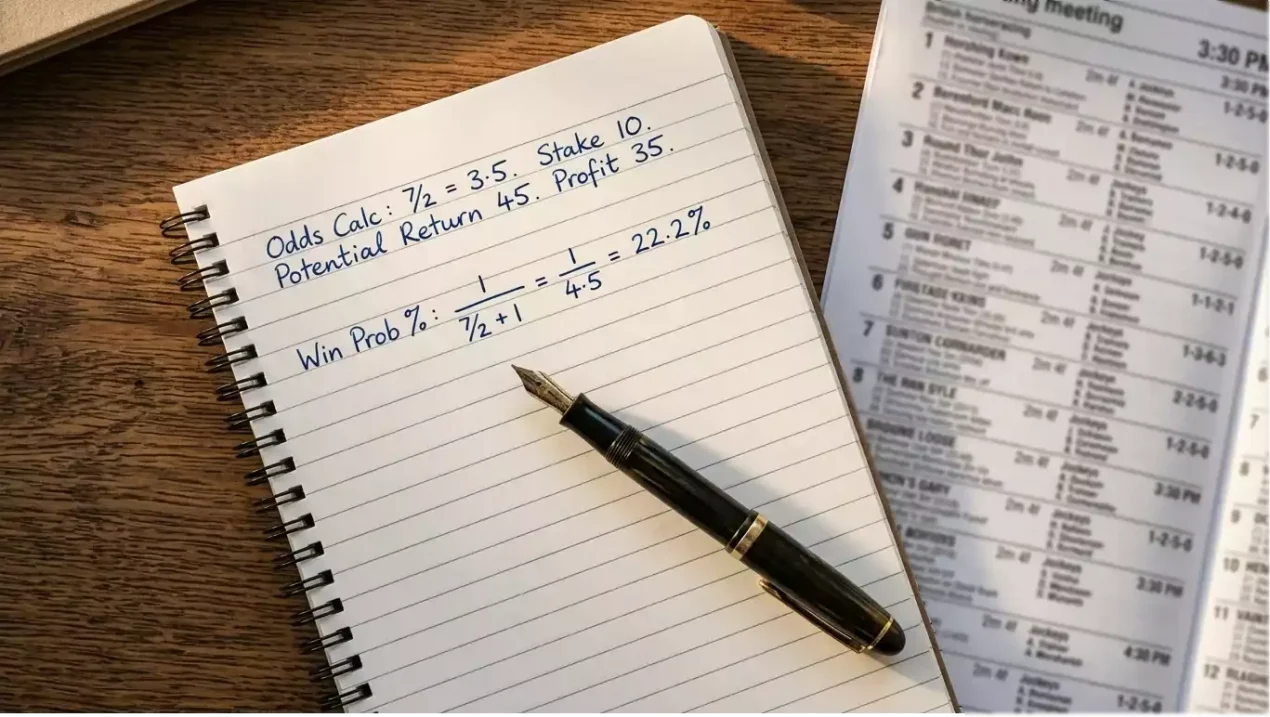
The formula isn’t difficult. There are three numbers and one multiplication. The trick is knowing which number goes where, and that’s what trips most punters up — not the maths, but the order of operations and the way fractional odds interact with the place fraction.
Return Calculations: Understanding Fractional Odds and Stake Handling
The basic structure of a UK place bet return is straightforward: you multiply your stake by the odds, divide by the place fraction, and add your stake back. In one line: return equals stake times place odds, plus stake. The complication is calculating the place odds, because they’re a fraction of the win odds. The standard fractions in UK racing are 1/4 of the win odds for fields of 5-7 runners and 16-plus handicaps, and 1/5 of the win odds for fields of 8-15 runners and non-handicaps with 8-plus runners.
Take a horse at 10/1 in a non-handicap with 12 runners. The place fraction is 1/5, so the place odds are 10/1 divided by 5, which gives you 2/1. A £10 place stake at 2/1 returns £20 in profit plus your £10 stake back, for a total of £30. The same horse in a 16-plus runner handicap, where the place fraction is 1/4, gives you place odds of 2.5/1, which means a £10 stake returns £25 profit plus stake — £35 total. Same horse, same stake, different race type, £5 difference in the return.
The point I want to drive home is that the place fraction is the variable that does the most work. People obsess over the win odds and forget that the place fraction quietly determines how much they actually take home if the horse runs into a place. A horse at 6/1 with a 1/4 place fraction pays more on the place side than a horse at 7/1 with a 1/5 place fraction. The price you see on the board isn’t the price you’re really betting — you’re betting the price filtered through the field-size rule.
Worked examples across the common odds bands
Let me run through a handful of examples that cover the prices you’ll actually see at a UK racecourse. Stakes are £10 in each case to keep the arithmetic clean.
At 5/2 in a 10-runner non-handicap, the place fraction is 1/5. Place odds become 5/2 divided by 5, which is 1/2. A £10 stake at 1/2 returns £5 profit plus £10 stake — £15 total. Notice that the place return is half the stake. This is the kind of structure that quietly drains bankrolls when punters take short prices each-way without thinking.
At 8/1 in a 12-runner handicap (1/5 fraction), place odds are 8/5. A £10 stake returns £16 profit plus £10 stake — £26 total. That feels much more like a result, which is why most experienced each-way punters cluster their bets in the 6/1 to 16/1 range.
At 20/1 in a 24-runner handicap (1/4 fraction), place odds are 5/1. A £10 stake returns £50 profit plus £10 — £60 total. This is where extra-place offers at the major festivals get interesting. The same horse at the same price, with the bookmaker paying six places instead of four, doesn’t change your potential return per cashed place bet — it changes the probability of cashing it.
At 33/1 in the same 24-runner handicap, place odds are 33/4, or 8.25/1. A £10 stake returns £82.50 profit plus £10 — £92.50 total. The numbers get serious at long prices, which is one reason place-only betting at outsider prices is structurally interesting on the right kind of horse.
Why decimal odds make the arithmetic faster
If you’re betting online with most modern UK operators, you’ve got the option of switching the display to decimal odds. I keep mine on fractional out of habit, but decimal odds make place-bet calculations much faster once you understand the shortcut.
Fractional 4/1 is decimal 5.00. Fractional 7/2 is decimal 4.50. The decimal price always includes your stake — it’s a multiplier rather than a profit ratio. To convert a fractional place fraction into a decimal multiplier, you take the win odds in fractional form, divide by the place fraction’s denominator (4 or 5), add one, and you’ve got the decimal place multiplier. So 10/1 at 1/5 places becomes 2/1 fractional, which is 3.00 decimal. Stake times 3.00 gives total return.
For mental arithmetic at the racecourse with a pen, fractional is usually easier because the numbers stay small. For anything online, decimal is faster because you can just type stake times multiplier into a calculator app and read the total return. The trap with decimal is forgetting that the displayed decimal odds are for the win, not the place — you have to do the place conversion yourself before you multiply.
One useful trick: most major online operators display the place return automatically in the bet slip before you confirm. If the displayed total return doesn’t match what you’ve calculated, recheck the place fraction the bookmaker is applying. A common error is assuming 1/4 when the bookmaker is using 1/5, or vice versa. The difference on a tenner at 14/1 is £7, and it’s worth knowing before you click “place bet” rather than after.
The common mistakes that cost punters real money
Three errors come up over and over in the messages I get from readers, and they’re worth flagging.
The first is treating the each-way bet as a single bet rather than two separate bets. When you stake £10 each-way at 20/1, you’ve staked £20 total — £10 on the win, £10 on the place. The win return at 20/1 from a £10 stake is £210 total. The place return at 5/1 from a £10 stake is £60 total. If the horse wins, you get both back — £270 total return. If the horse places without winning, you get only the £60. People look at the £270 and think they’ve won big from a £10 bet, forgetting they staked £20.
The second is forgetting to check the place fraction when the race type changes. A 10-runner handicap pays at 1/5, three places. A 16-runner handicap pays at 1/4, four places. Same field size in either direction can flip the fraction. If you’ve assumed 1/4 on a race that actually pays 1/5, your expected place return is 20% lower than you thought. The structural difference matters, and the only way to avoid the mistake is to verify the fraction on the bet slip every time. The breakdown of each-way and place-only mechanics goes through this distinction in more detail.
The third is misreading the place position when the race is settled. UK place bets pay if your horse finishes in any of the qualifying positions — first, second, third, sometimes fourth or more. They don’t pay for “near-miss” finishes that fall outside the published place band. If the race pays three places and your horse finishes fourth, the place portion of your each-way is lost. There’s no consolation money. The bet is binary on the place side, the same way the win side is binary.
A fourth error worth a mention is dead-heat reduction. If two horses tie for a place position, both are paid out but at a reduced rate — typically half the normal return. This catches people out at the racecourse when they think they’ve cashed a full place ticket and find the dividend is half what they expected. Dead heats are rare but not negligible, and any serious place punter should understand the rule before staking on a tight field.
Putting the formula to work without a calculator
The reason I think this matters is that getting comfortable with the arithmetic changes the way you bet. When you can run the numbers in your head, you stop taking short-priced each-way bets where the place return is barely a return at all. You start noticing the races where the price and the place fraction line up to give you genuinely good place expectation. You catch your own mistakes before the bookmaker catches them for you.
The formula is stake times odds times fraction, plus stake. Memorise the three variables, get fluent at the place fraction conversion, and you’ll find the racecourse experience changes. You’ll know what you’re holding before the race goes off, you’ll know what to expect at the cash-out window, and you’ll stop being the person holding up the queue at Ascot trying to work out where the missing two pounds fifty went.
How do I convert fractional place odds into a decimal multiplier?
Take the fractional win odds, divide by the place fraction’s denominator (4 or 5), add 1, and the result is the decimal multiplier for the place return. So 10/1 at 1/5 places becomes 2/1 fractional, which converts to a 3.00 decimal multiplier — stake times 3.00 gives the total place return including stake.
Why does the place return differ when the same horse runs in a 14-runner vs 16-runner field?
The field-size threshold of 16 runners in handicaps moves the place fraction from 1/5 to 1/4 and adds a fourth place to the qualifying positions. A horse at 10/1 in a 14-runner handicap pays 2/1 for placing in the top three. The same horse at 10/1 in a 16-runner handicap pays 2.5/1 for placing in the top four — a 25% improvement on the place side.
This material was created by the PlaceLedger team.
Related posts

In-Play Place Market Mechanics: How Live Pricing Actually Works During a Race

UK Betting Taxation: How the Punter’s Tax-Free Status Actually Works